
Juvenile Detention Role
The Lake County Juvenile Detention Center page describes a secure juvenile facility with education, recreation, medical care, mental-health services, and secure detention alternatives. It should not be described as an adult jail, a sheriff work-release center, or a state prison. Juvenile detention is tied to court and law-enforcement process for minors, and public access to names or case details is much more restricted than adult jail booking access.
The county page emphasizes services rather than a public custody list. Education continues home-school credits, with structured classes including life skills, physical education, science, and recreation. After-school and weekend classes may include remedial math, language arts, reading, and GED preparation when applicable. Medical services include two full-time nurses, a nurse on call, intake medical assessment, medication handling when a parent or guardian brings prescribed medication, and coordination with doctors or hospitals.
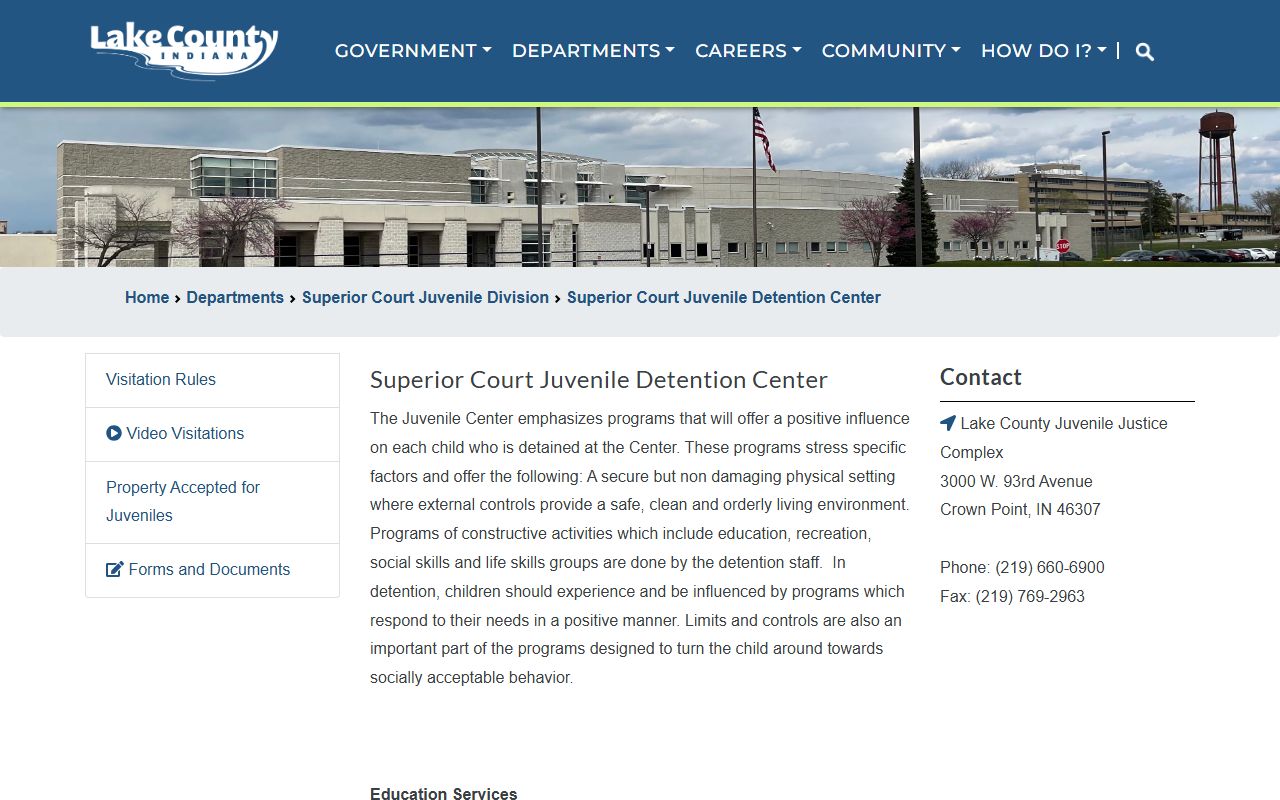
Source image: Lake County Juvenile Detention Center official page.
Juvenile Detention Capacity
The research did not locate a current capacity number on the county juvenile detention page. Indiana Department of Correction maintains a juvenile detention center inspection and audit report index that lists Lake County audit reports through 2025, but the facility page itself does not publish a public daily population count, resident list, or demographic table. Because juvenile records are restricted, the absence of an online population list is expected and should not be filled with third-party claims.
| Measure | Published Status | Reason It Matters |
|---|---|---|
| Facility capacity | Not located on county page | Do not invent a bed count |
| Current resident roster | Not public | Juvenile access is restricted |
| Audit history | IDOC index lists Lake County reports through 2025 | Use audits for oversight, not youth lookup |
Juvenile Detention Lookup Limits
A Lake County Juvenile Detention Center lookup is not handled like an adult inmate search. There is no public juvenile roster, no public mugshot gallery, and no adult jail booking profile for detained youth. Parents, legal guardians, attorneys, and authorized court participants should contact the facility or juvenile court directly. Others may not be entitled to confirmation or details.
- Call the Juvenile Detention Center at (219) 660-6900 if the caller has a lawful family, guardian, attorney, or court-related reason to ask.
- Use the juvenile court contact path at the Lake County Juvenile Justice Complex for court schedules or authorized case access.
- Do not use adult jail roster sites, commercial mugshot pages, BOP, ICE, or IDOC adult prison tools for juvenile detention lookup.
- Ask the facility what identification, guardianship proof, attorney role, or court authorization is required before information can be released.
Adult custody searches belong with Lake County Jail, sheriff records, MyCase, or IDOC depending on the person's status. Juvenile detention is a separate system with stronger confidentiality boundaries.
Juvenile Detention Contact
The juvenile facility is on West 93rd Avenue in Crown Point, near other juvenile justice functions. The visitation PDF gives the address and rules for approved visitors. The main phone number should be used before travel, especially during severe weather, staffing changes, or questions about whether a person is authorized to visit.
Lake County Juvenile Detention Center
3000 W. 93rd Avenue
Crown Point, IN 46307
(219) 660-6900
Secure juvenile detention and juvenile court contact route
Juvenile Detention Visits
The juvenile visitation policy, updated October 2025 in the research materials, allows residents three total visits per week from Monday through Saturday. Regular visiting hours are 7:00 p.m. to 9:00 p.m., with no entry after 8:30 p.m. Sunday is reserved for special visitations. The policy restricts approved visitors to parents or legal guardians, grandparents, step-parents, and siblings over 18. All visitors must provide photo identification.
| Topic | Juvenile Detention Rule | Important Limit |
|---|---|---|
| Weekly visits | Total of three visits per week, Monday-Saturday | No entry after 8:30 p.m. |
| Hours | 7:00 p.m. to 9:00 p.m. | Call ahead during severe weather |
| Sunday | Special visitations | Not standard public visiting |
| Approved visitors | Parents or legal guardian, grandparents, step-parents, siblings over 18 | Only two visitors per resident at one time |
| Identification | Photo identification required | First sibling visit requires birth certificate |
| Visit length | May be limited to 30 minutes if full, 15 minutes if short-staffed | Facility needs control length |
Juvenile Mail Phone Property
The research materials did not locate a juvenile commissary or money-deposit table like the adult jail and Community Corrections pages. For juveniles, property, medication, school items, phone contact, and family communication are more controlled. The county page does publish medical details: prescribed medication must be brought by a parent or guardian, and the facility coordinates with doctors and hospitals when needed. That makes direct facility confirmation essential before bringing any item.
| Service | Documented Detail | Access Limit |
|---|---|---|
| Medication | Medication dispensing when parent or guardian brings prescribed medication | Confirm packaging and approval rules first |
| Medical services | Two full-time nurses, nurse on call, intake medical assessment | Medical details are not public roster data |
| Mental-health services | Clinical psychologist and full-time therapist | Access depends on court and treatment rules |
| Money or commissary | No public juvenile money table located | Call facility before bringing funds or property |
Juvenile Detention Programs
Lake County's juvenile detention page gives unusually specific service detail. Education continues home-school credits and uses a structured class day. The facility also offers life skills, physical education, science, recreation, remedial classes, and GED preparation when applicable. Medical and mental-health services are part of the facility structure, including evaluations after detention hearings and referrals as ordered.
The county also describes secure detention alternative programs. These include In-House Detention, In-House Detention level 2 with monitor, Intensive Probation, and Intensive Probation level 2 with monitor. These alternatives are not public lookup tools. They are court-linked options that may affect where a youth is placed and how the youth is supervised.
- Secure juvenile detention
- A locked youth facility used through court or law-enforcement process.
- Detention hearing
- A juvenile court event that can affect continued detention, release, or services.
- In-house detention
- A secure detention alternative listed by the county for some youth.
- Intensive probation
- A higher supervision juvenile alternative, sometimes paired with monitoring.
Juvenile Record Access Limits
Juvenile records are not adult jail records. Indiana public-record access rules can make some arrest and jailed-person information public for adults, but juvenile cases and youth detention records often involve confidentiality, court control, education privacy, medical privacy, victim protection, and family privacy. A person who could search an adult court docket or call an adult jail may not be entitled to receive a juvenile's detention status.
Do not use the Lake County adult jail, IDOC adult locator, BOP locator, ICE locator, or commercial mugshot sites as substitutes for juvenile court access. If a youth is later waived or charged in a way that creates an adult public record, the public access route may change, but that is a court-specific issue. For routine juvenile detention, use the facility and juvenile court channels.
Note: Juvenile custody and case details are restricted; call the facility only if you have a lawful role or authorization.